Indoor Plants for Architects & Interior Designers
You finish a project you’re proud of. The client is delighted, the photographs are taken, the handover is signed. Three months later you’re back for something unrelated, and the plants look terrible. Yellowing leaves in the reception. A statement ficus dropping foliage onto a client’s oak flooring. A watermark spreading on the plinth you detailed.
Nobody blames the plants. They remember whose project it was.
📌 What this guide covers
We work alongside architects and interior designers on projects across Pune, and the same ten mistakes come up again and again — none of them because anyone was careless.
Below: the ten mistakes and the challenges behind them, why each happens, and exactly how Alpine Greens solves each one.
The one mistake behind all the others
Plants are almost always the last line on the schedule. By the time they’re considered, the joinery is built, the lighting is committed, the services are run and the furniture is placed. At that point greenery can only go where there happens to be room — which is rarely where it would do the most good, and often where it cannot survive.
Greenery is also the only element in an interior that is alive. It either improves after handover or visibly deteriorates. There is no neutral middle. Everything below is downstream of treating a living system as a final-stage finish.
Mistake 1 — Specifying plants for the moodboard, not the conditions
Light decides everything — not the render. A plant chosen for how it looks will fail if the zone can’t sustain it.
Central AC strips humidity continuously. Sensitive species brown at the leaf tips within weeks.
A desk forty feet from a window runs on artificial light alone. Very few species genuinely cope.
Too short for a double-height volume reads as an apology. Too broad for circulation gets brushed past daily.
🔎 A field test needing no light meter: if the artificial lighting has to be on at midday for the space to function, treat that zone as low-light. Only a handful of species truly thrive there — Snake Plant, ZZ Plant, Aglaonema and Pothos. Everything else is a slow, expensive failure.
🌿 How Alpine Greens solves it
We assess light and AC behaviour zone by zone on site before recommending anything, and we schedule plants at mature dimensions against your ceiling heights and circulation widths. Because plants are rented rather than sold, we carry the risk of getting it wrong — so we have no incentive to specify something that won’t last.
Mistake 2 — Planning greenery after the layout is frozen
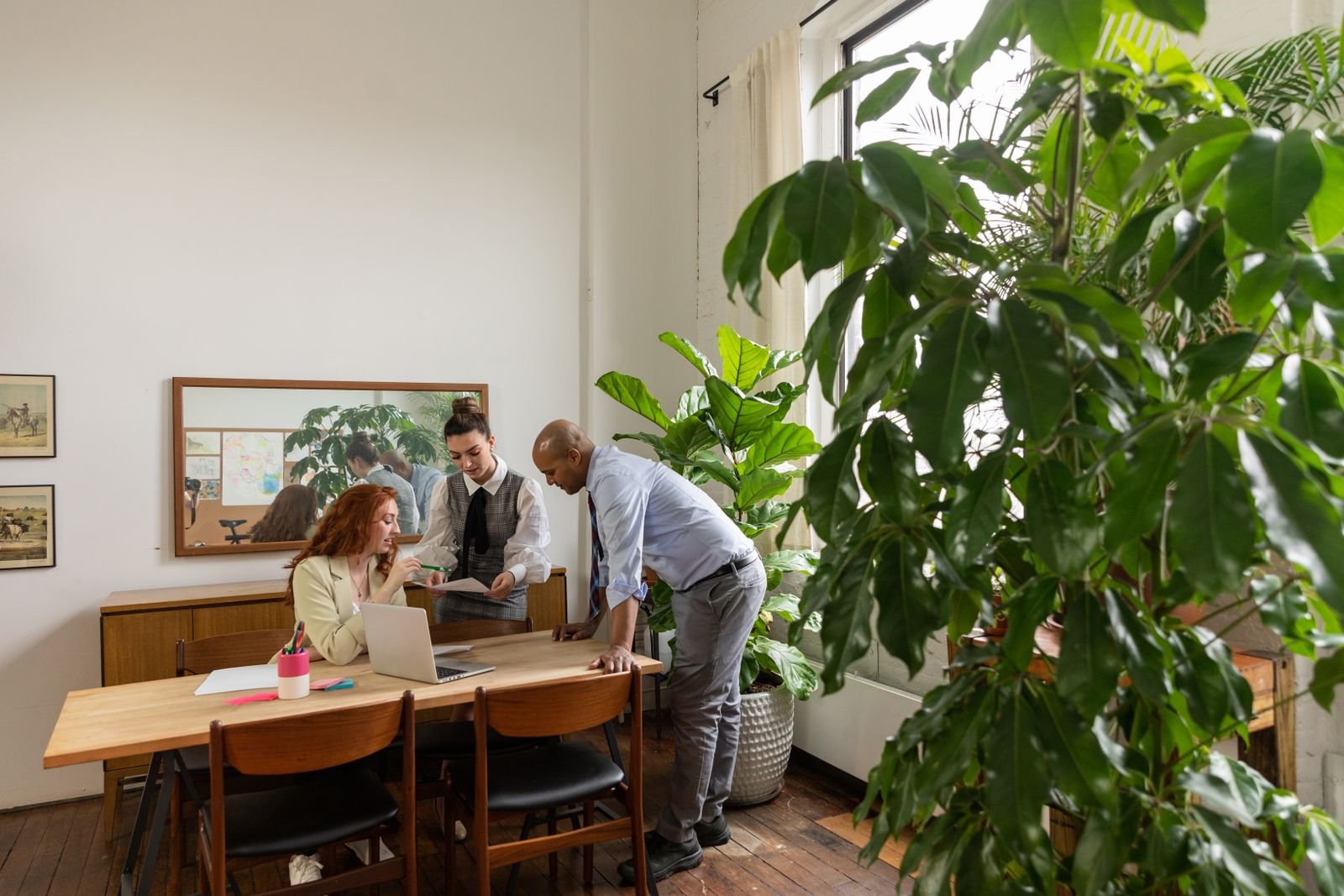
Plan greenery while the layout is still moving and it becomes an active design tool — softening a long circulation run, marking a transition, screening a workstation cluster, giving a reception its focal point. Plan it afterwards and it becomes pots in leftover corners.
Sequencing also governs what you can actually obtain. Availability is a real execution constraint. A large, well-formed specimen takes years to grow; a particular size, form or planter finish may need lead time. When the plant schedule appears only at fit-out stage, substitutions get made under pressure — and substitutions are how a considered scheme quietly becomes a generic one.
🌿 How Alpine Greens solves it
We come in at drawing stage. Share the plan and we’ll walk the space with you and mark up where greenery genuinely works before the layout locks. And because we grow our own stock at our Pashan nursery, we confirm availability of specific sizes and finishes against your programme dates — instead of you discovering a substitution on installation day.
Mistake 3 — Not detailing for water and access
Water damage is the failure with a real invoice attached. Open drainage sitting directly on timber. A saucer overflowing onto a rug. Moisture wicking into the base of a plastered wall or the plinth you detailed. This is a wet-detail problem, not a gardening problem, and it is solved the way any wet detail is — a sealed outer planter, a removable inner liner, no standing water touching any finish, and a decision made in advance about where excess water goes.
Maintenance access is the constraint nobody draws. Trailing greenery on a high shelf photographs beautifully. Someone now has to reach it safely, every week or two, for the life of the space. The same applies to plants tucked behind furniture in narrow corners — and especially to vertical gardens, which are serviceable systems with irrigation, drainage and replacement access, not finishes.
Before committing to any position, ask one question: how does a person physically reach this, and what do they stand on?
🌿 How Alpine Greens solves it
We specify planters to your material palette and detail the build-up so no water ever meets a finish — sealed outer vessels, raised removable liners, defined overflow. At survey stage we flag any position that will be difficult to service, before it is built, and we recommend self-watering planters where access is genuinely hard.
Mistake 4 — Leaving maintenance unassigned at handover
Plants decline because care becomes nobody’s job. “Housekeeping will handle it” reliably means enthusiastic overwatering for a fortnight, then nothing for a month. Overwatering — not neglect — kills most indoor plants, and it is the natural failure mode when a well-meaning person waters on a fixed day regardless of what the plant needs.
In premium interiors, cleanliness is a specification issue. Fallen leaves on stone. Loose soil around a planter rim. Dust dulling foliage where every other surface is immaculate. A pest problem noticed only once it has spread. In a high-specification interior these details undermine the work more than no plants at all would have.
And most fundamentally — no named maintenance owner. If the handover documentation doesn’t say who maintains the greenery, on what schedule, and who replaces a plant that fails, the answer is nobody. The outcome is decided on day one.
🌿 How Alpine Greens solves it
Our AMC names the responsible party, the visit frequency and the replacement terms — so your handover documentation has a real answer instead of a gap. We service on a fixed schedule covering watering, pruning, leaf cleaning and pest control, and anything not thriving is replaced free. Your client never lives with a declining specimen, and nobody argues about who pays.
The ten mistakes, and how we solve each
| The mistake | Why it happens | How Alpine Greens solves it |
|---|---|---|
| Wrong species for light, AC or humidity | Specified from aesthetics, not conditions | On-site light and AC assessment before any selection |
| Insufficient natural light for the plants chosen | Deep floorplate, no daylight study | We restrict to proven low-light species or flag the need for lighting |
| Wrong placement | Greenery planned after layout freeze | We join at drawing stage and mark up placement with you |
| Plant size mismatched to ceiling and furniture | Mature size never checked | We schedule plants at mature dimensions, not delivery size |
| Watering damage to floors, walls, furniture | No planter build-up detailed | Sealed outer planter, raised removable liner, defined overflow |
| Maintenance impossible to reach | Access never drawn | We flag hard-to-service positions at survey, before build |
| Vertical garden neglected and failing | Treated as a finish, not a system | We plan irrigation, drainage and module replacement access |
| Poor plant health after handover | Care left to untrained staff | Contracted servicing from day one, free replacement of any failure |
| Pests, fallen leaves, soil and dust | No servicing schedule | Covered soil and leaf cleaning on every scheduled visit |
| Plants or planters unavailable at execution | Schedule shared too late | We grow our own stock and confirm availability against your dates |
The workflow that prevents all ten
Site Assessment
Light, AC behaviour and humidity read zone by zone.
Plant Selection
Species matched to measured conditions, not the moodboard.
Placement Planning
Positions fixed while the layout is still moving.
Planter Selection
Finish matched to your palette, build-up detailed against water.
Installation
Placed to the plan, timed to your programme.
Maintenance AMC
A named party, a fixed schedule, replacement included.
Why working with Alpine Greens changes the outcome
We’re a working nursery in Pashan supplying plants to offices, hotels, hospitals and commercial projects across Pune on a rental basis — and that model changes the incentives in a way that matters to you:
The replacement risk is ours, not your client’s. Anything that stops thriving is swapped free. A specification mistake becomes our problem to fix rather than a conversation about who pays.
We can be involved before the layout locks. The earlier we see the plan, the more of the ten mistakes above simply never occur.
Maintenance is contracted, not assumed. Your handover documentation gets a named party and a schedule.
We grow what we install. Holding our own stock is what makes specific sizes and fast, same-species replacements possible.
Your project keeps looking like your project. Which is ultimately the point — the greenery in your photographs should still look that way when a client walks the space two years later.
📚 Go deeper — the rest of this series
🌿 Plants for low-light and air-conditioned offices — the specification guide, by light zone.
💧 Planter drainage and detailing — protecting floors, walls and furniture from water damage.
🔧 Who maintains the plants after handover? — designing for reach, and naming an owner.
We work this way on corporate offices, hotels and banqueting venues, hospitals, and malls and commercial complexes — each with its own constraints.
Book a Free Site Visit
Working on a project now? Send us the drawings or walk the space with us — we’ll assess the light and layout zone by zone and send you a written quote, no obligation. Earlier is better: bring us in before the layout is frozen and there’s far more we can do.
📞 +91 95117 44907 💬 WhatsApp Us
⭐ Rated 4.9/5 from 360+ Google reviews · Alpine Greens Plants Nursery, Pashan, Pune